Earlier work · Social Network Analysis
Network Analysis of the AirPower Cancellation
Analysed about 30,000 tweets as Apple cancelled AirPower: sentiment, emoji use, how the network exploded, and which influencers spread it worldwide.
Background
Apple announced AirPower, a mat that could charge several Apple devices at once regardless of where they were placed, in September 2017. It was quietly removed from Apple’s website a year later amid reports of overheating and other technical problems. On 29 March 2019, Apple cancelled it, the company’s first-ever cancellation of an announced hardware product.
The question: how did the public react on social media, who drove the conversation, and how well did Apple handle the crisis?
Data
Tweets were collected with the Twitter API (rtweet in R) using keyword pairs such as AirPower + Apple and AirPower + AirPods:
| Period | Tweets |
|---|---|
| Before the cancellation (25-29 March 2019) | 2,984 |
| After the cancellation (29 March - 4 April 2019) | 26,513 |
Text analysis
- Word clouds before the cancellation showed excitement and anticipation about a release date. Afterwards, frustration took over.
- Emoji analysis with the
emojipackage told the same story, shifting from excited to negative. - VADER sentiment was scored per tweet, then rolled up to each user and each location.
Network analysis
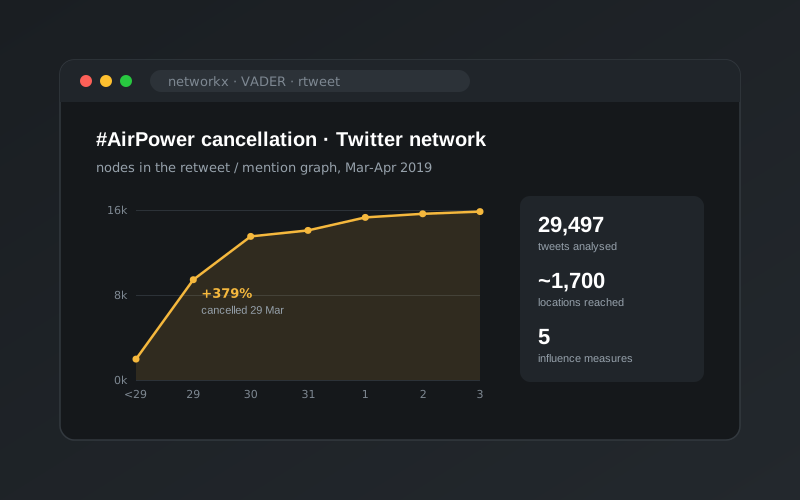
The retweet and mention network exploded on the day of the announcement:
| Date | Nodes | Edges | Node growth |
|---|---|---|---|
| Before 29 March | 1,969 | 2,175 | — |
| 29 March | 9,441 | 12,272 | +379% |
| 30 March | 13,519 | 17,838 | +43% |
| 3 April | 15,854 | 21,056 | +1% |
Finding top influencers. Each user got an influence score: an equal-weighted mix of five measures, each normalised to a 0-1 scale:
- out-degree
- follower count
- listed count
- closeness centrality
- betweenness centrality
Questions answered:
- Were influencers positive or negative? In most locations, negative influencers outnumbered positive ones.
- Where were they? They were concentrated in tech hubs, especially the US, India and London.
- Who connected different communities? Users with the highest betweenness centrality bridged otherwise separate groups.
- Local or global? Global. Top influencers reached almost 1,700 locations worldwide.
Recommendations to Apple
- Use the official Twitter account proactively. Address issues directly instead of letting rumours spread from user to user.
- Work with influencers. They can amplify negative sentiment or misinformation, so monitor them and consider collaborations, sponsorships or early product testing.
- Fix internal communication. Better transparency between technical and management teams could prevent a two-year promise that couldn’t be delivered.
- Forecast risk realistically. Building anticipation for two years only works if the product is achievable.
Limitations
- Only 10 days of data (about 30,000 tweets).
- No demographic attributes such as age or gender were available from the API.
- Location fields were messy.
- With more history, users who are always negative about Apple could be separated from those reacting to this event.