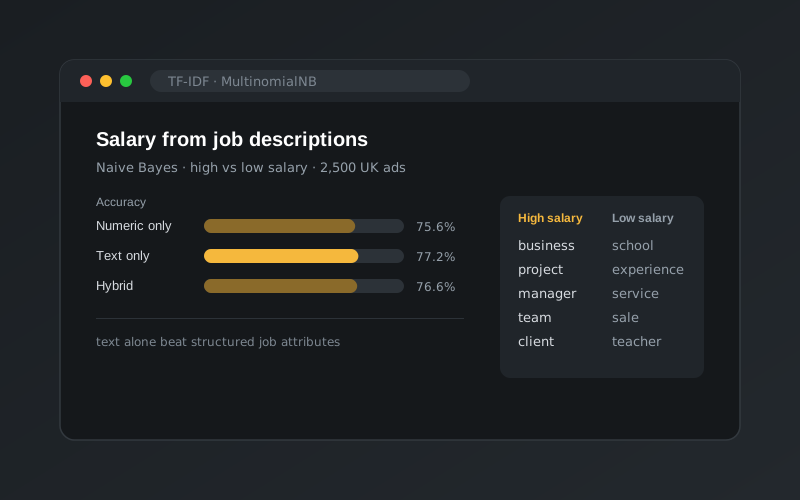
Compared Naive Bayes models on job-posting text, job attributes and both combined to predict high versus low salary. The text-only model won with 77.2% accuracy.
How much does the wording of a job posting reveal about its pay? This project tests the predictive power of text against structured job data, using the Kaggle Job Salary Prediction dataset of UK job ads (training file train_rev1).
Salaries were turned into two classes: high (75th percentile and above) and low (below the 75th percentile).
Data preparation
Rows with missing values were removed and 2,500 postings were randomly sampled.
Text was cleaned: punctuation removed, lowercased and lemmatised.
Missing contract fields were filled with sensible defaults: if not part-time, then full-time; if not contract, then permanent.
A flag was added for postings in high cost-of-living locations such as London, Oxford, Cambridge, Bristol, Reading, Edinburgh and Leeds.
Exploring the text
Nouns and adjectives dominate job descriptions: positions are described by what the role is and what it’s like.
Word frequencies closely follow Zipf’s law: a few words are very common and most are rare.
The most common words after cleaning were experience, role, team, client, business, work, working, skill, service and within. Recruiters mostly ask for experienced, team-oriented, client-facing people.
Models
All three are Naive Bayes classifiers:
Model
Predictors
Accuracy
Precision (high)
Recall (high)
Numeric only
Contract type and time, category, high-cost location
75.6%
70.0%
10.8%
Text only
TF-IDF of the job description
77.2%
59.3%
39.2%
Hybrid
Text and numeric predictors
76.6%
57.5%
38.5%
Findings
Text alone performed best. The words in a posting predict pay better than its structured attributes. The numeric model barely beat always guessing “low”, catching only about 1 in 10 high-salary jobs.
Adding the numeric features didn’t help. The hybrid model scored slightly lower than text alone, as the extra, weaker features added noise.
High- and low-salary postings use different vocabulary:
Rank
High salary
Low salary
1
business
school
2
project
experience
3
experience
role
4
manager
service
5
team
sale
High-paying ads lean towards management, projects and finance. Lower-paying ads lean towards schools, sales and service roles.