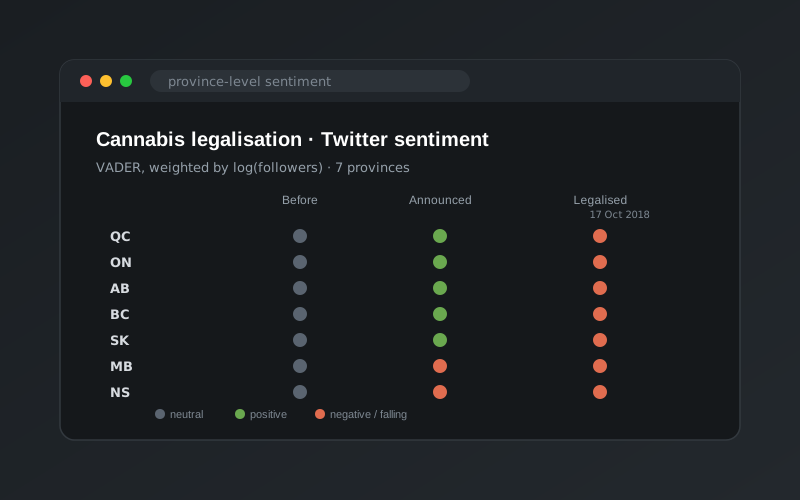
Province-by-province Twitter sentiment before and after cannabis legalisation, weighted by follower reach, to recommend how to roll out controversial policies.
Canada legalised recreational cannabis on 17 October 2018, a federal decision carried out province by province. This project asks: how should a country with many provinces roll out a controversial policy? It answers by measuring how public sentiment changed in each province before and after legalisation, and why.
Data
Tweets, collected per province. The twitterscraper tool was used with keyword queries combining legalisation, cannabis terms and the province name, for example legalization AND weed AND quebec. This covered 7 provinces: Quebec, Ontario, Alberta, British Columbia, Manitoba, Nova Scotia and Saskatchewan.
Follower counts. A Selenium and BeautifulSoup scraper collected each tweeting user’s follower count, to measure how influential they were.
Method
Pre-process the tweets: lowercase, tokenise, remove stop words and lemmatise.
Explore the most frequent hashtags and words in each province, with and without hashtags, to see what people actually discussed.
Score sentiment for every tweet with VADER. A compound score above 0.1 counts as positive and below 0 as negative.
Compare three periods for each province: before the announcement, between announcement and legalisation, and after legalisation.
Weight by influence. Each tweet’s sentiment was multiplied by the log of the author’s follower count, so influential accounts count more. The log tames the huge spread in follower numbers.
Findings
Before the announcement, sentiment was broadly neutral everywhere.
After the announcement, most provinces turned positive, seeing legalisation as a way to boost the economy, control use and shrink the black market. Manitoba and Nova Scotia were the exceptions, and they were the first provinces to publish fines for breaking cannabis rules (up to $2,500 in Manitoba, and $25 to $10,000 in Nova Scotia depending on the offence).
After legalisation, sentiment fell in every province, driven largely by supply shortages and prices. Quebec ran out of legal stock within hours, and its legal price rose about 17% to $8.02/g, against roughly $6.50/g on the black market. Other complaints were a shortage of stores in Saskatchewan’s big cities and slow retail licensing in British Columbia.
Influence-weighted sentiment followed the same pattern, suggesting public opinion was shaped by influential accounts whose posts reached the most people.
Recommendations
Pilot first. Test a sensitive policy in one province before rolling it out nationally, so problems such as supply and pricing can be fixed before they sour sentiment everywhere.
Treat social media as a listening channel. People use it to learn about and debate policy, so it’s one of the fastest ways to gauge reaction.
Engage influential voices early. Their sentiment is a leading indicator of the wider population’s.
Limitations
Only English tweets were collected, which misses much of the conversation in Quebec.
Tweet volumes differed a lot between provinces.
Follower counts reflect the time of scraping, not the time of each tweet.